Showing posts with label tip. Show all posts

Friday, 27 June 2008

Battery Woes & Coconuts

FinderScreenSnapz001.png

Why is it that all laptop batteries eventually die?

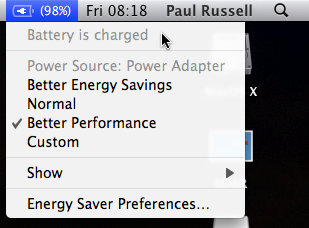
Whenever I charge my MacBook Pro completely, the battery meter stops at 98%, and the battery says it's charged. I'd like to think this just means that I get 2% less charge than I used to, but the reality is far less appealing. When I unplug the juice, my laptop informs me I've got 1:33 to live. I used to get at least 2:30.

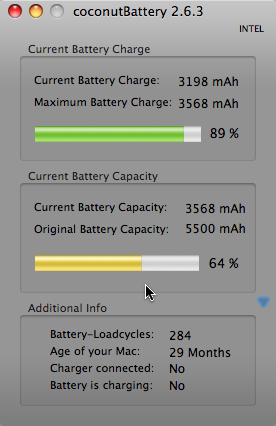
I know it's a reality that laptop batteries behave like this, and I'm aware that nothing short of a breakthrough in chemistry is likely to change this, but what I would like to see is some kind of transparency about the state of the battery - an advanced battery meter if you like. Something that shows the theoretical battery capacity, the charge attained last time it was full and it's current level. The meter could also show the number of 'charge' cycles the battery has been through to provide a view of the likely useful life of the battery.

I guess it would look a little like this:
coconutBatteryScreenSnapz001.png

Thankfully, someone's gone to the trouble of doing exactly that. CoconutBattery provides all of the above information at a glance, allowing you to understand exactly the position you're in. Which in my case is that I'm the proud owner of one of the oldest MacBook Pro's on the market (29 months? Has it really been that long?), and its battery is getting a bit weary. Perhaps it's time to buy a new one...

Saturday, 8 March 2008

So what is service reuse anyway?

Keep climbing and you might just get some reuseJust read an post over at InfoWorld by David Linthicum. The central point of David's post is that reuse shouldn't be considered or advertised as the 'core value' of SOA. I totally agree with that, particularly as often, organisations still insist on setting up SOA projects, rather than changing the mindset and method of working to encourage the adoption of SOA across projects.

To me, half the problem with the reuse argument is that people don't have a clear understanding of what is meant by the term. Often, people consider that reuse is only achieved when a service has more than one consumer within the SOA at a point in time, but (to me) that's missing the point. An SOA is not a static environment; in a well managed organisation, it'll change almost continuously. To me, you're achieving some level of reuse whenever you fundamentally change a business process without having to re-hash all of its services, or you don't have to bother re-testing every combination of parameters to a complex business process because you know already that the services that underly it, which make all the hard decisions about someone's credit worthiness have been tested thoroughly already. You even get re-use whenever you say "Ah, well, we'll apply our standard grade message integrity policy to that service, so we know how to achieve that".

If you take this broader view (let's call it long-term reuse), then long-term reuse and agility become somewhat interchangeable concepts - you get agility through being able to reuse a service across two versions of the same process, by knowing that you've already tested a given service to death, and by not having to make complex technical design decisions each time you create a 'new' service.

So. I agree that the reuse should not be used as an advertising 'headline' for SOA, because in an advert (be it literal or spoken), you don't really have the time or bandwidth to get some of the subtleties of the above across. But in reality, over the medium term, I think we will find that the long-term reuse achieved (assuming for a moment you buy into my definition) is significantly higher than people currently expect.

The last point I'd make is this: If you design your services for immediate reuse, you will likely fail to achieve that re-use. If on the other hand, you design your services for change, and aggressively factor new functionality into them as new consumers require it, I suspect you'll find even 'point in time' reuse increases dramatically over the medium term.

Wednesday, 5 December 2007

SOA Rules of Engagement

Many organisations struggle to get their SOA off the ground. The reasons vary, but mostly stem from getting the very simple things wrong at the start. The following are my 8 simple rules for a successful SOA implementation:
  • Don't forget the constructive tension. For SOA to be a success, there needs to be a tension between the desire to do things now, and the desire to do things right. This means setting up a governance function to complement (note: complement, not obstruct) your delivery function.
  • Don't forget to deliver something useful early. SOA business cases are notoriously hard, because many (not all) of the benefits arrive in the longer term, and will only be realised if other projects behave as expected. By far the best way to get on in this world is to deliver some business benefit early. Your sponsors will thank you, and it's not as hard as you think - SOAs are all about managing change afterall, so you can do a lot just by delivering a sequence of relatively small incremental projects.
  • Don't boil the ocean, the fish won't like it. Many many SOA projects try and 'SOA-enable' huge swaithes of their technical architecture in one foul swoop. It's a well established near-fact that it's difficult or impossible to achieve. I've only worked on one project where this worked, and that was because it was a spin-off from a large company, and so had only a small amount of 'heritage' (nee legacy) systems to contend with - most of the services were built from the ground up.
  • Don't worry about the technology. Technology is usually far from the biggest risk to a large SOA programme. Weak benefits cases, poor governance, poor expectation management or a changing political/economic environment are far more likely to be your downfall.
  • Do worry about the technology. Having said that technology is not the biggest risk, it is a significant risk. Keep it simple. Implement just the functionality and infrastructure you need in the first instance. Don't believe people or companies that tell you that SOA is a product, or is simply a technical problem that they can solve for you.
  • Do get strong project management, but keep them in their box. As I've alluded to above, there are tons of risks waiting to consign your SOA aspirations to the great ESB Gateway in the Sky, so you'll need an excellent project manager to manage them for you. By excellent, I don't mean they're a dictator, I mean they're an enabler for your team, and a black belt in motivation, reporting, and risk management. Whatever you do: If they're running the delivery of a project, do not allow them to become responsible for your organisation's SOA governance. There be dragons.
  • Do get an all star cast (at least initially). The nature of SOA is such that there is a lot of opportunity for working smarter rather than harder, which will get you to market faster, make your SOA easier to maintain, and cost you less. Get yourself a team of technical people who really know their bananas; quality is vastly more important than quantity. Seriously consider going outside your organisation to secure at least part of your core team - the people in the next room might be brilliant, but experience is everything in the SOA world. Architects, business/system analysts, developers and testers are all important, and you'll need them to work in perfect harmony for your SOA to really take off.
  • Do make sure you're involved. It might be tempting at times to bury your head in the sand, and allow someone else to 'do SOA to you', but don't let this happen. While it's important to get that all star cast, it's also critical that your organisation learns from any 'outsiders', and will be capable of taking the reigns in the long term. That said, do consider keeping outsiders in the mix for the long haul - the world is changing rapidly, and keeping people who've seen other organisations make mistakes close to you will enable you to dodge the pitfalls that consume your competitors.
Comments and your rules, as ever, welcome.