Showing posts with label software. Show all posts

Friday, 20 March 2009

Lies, damned lies and statistics

A client I'm working with that the moment has been doing some work around calibrating an estimating model. This model is based on allocating deliverables passing through the project a number of 'points', based on their perceived complexity, and then creating a weighted estimate based on these points. We decided to calibrate the model using a more detailed estimate of a random sample of these deliverables.

A quick review of these figures yesterday revealed a strong correlation(around 0.85) between the number of points allocated to an item, and its resulting estimate. "Hurrah!", we said. Then we said: "This model is useful, and can give us a reasonable estimate of any given subset of the overall project and therefore in particular, of each of our planned iterations." Things were good. Then we twigged.

When we ran the calibration workshop, we asked people to estimate each deliverable. When we described these deliverables, we gave a brief description of the scope of the deliverable, and mentioned the number of points allocated to the deliverable. Nothing wrong with that, right? Well, we decided to do a little experiment, and re-ran the same test, with the same people, but a different set of deliverables. This time, we didn't tell them the number of points allocated to each deliverable.

The correlation was now 0.19. By most definitions, this means there is no correlation whatsoever. Our model is broken.

So, what's going on there? I think (and I'm no statistician) that we're seeing human nature at work. If you tell people something is twice as hard as something else, they're inclined to estimate it'll take roughly twice as long. If you estimate something is three times as hard, the estimate will be three times as long. When we estimate, we don't know we're doing this, as our gut (rather than our head) is doing the heavy lifting here - it's hard to apply a lot of intellectual muscle to something that's ill defined. Gut bases its decision on whatever information is easily available; in this case, someone just told us this thing is 'hard, twice as hard as the last thing', so the number we come up will start off roughly twice as high. If we get some information that makes us believe it's simpler than this, then we might try and adjust Gut's estimate downwards a little, but we'll likely never estimate it totally objectively after being told initially that it's 'hard'.

Thankfully, for us, this hasn't caused a problem. We're mainly interested in the overall averages rather than the specific estimates. We can still predict reasonably accurately the overall length of the project, even if we're a little out on the fine details. The lesson here is clear though: Be careful how much trust you put in these kinds of estimating excercise. They may not be as scientific or accurate a you first believe.

Friday, 27 June 2008

Battery Woes & Coconuts

FinderScreenSnapz001.png

Why is it that all laptop batteries eventually die?

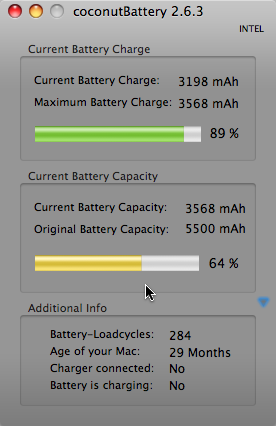
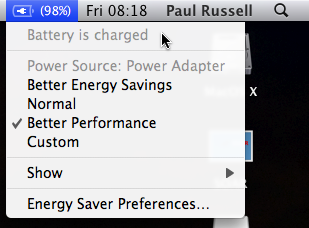
Whenever I charge my MacBook Pro completely, the battery meter stops at 98%, and the battery says it's charged. I'd like to think this just means that I get 2% less charge than I used to, but the reality is far less appealing. When I unplug the juice, my laptop informs me I've got 1:33 to live. I used to get at least 2:30.

I know it's a reality that laptop batteries behave like this, and I'm aware that nothing short of a breakthrough in chemistry is likely to change this, but what I would like to see is some kind of transparency about the state of the battery - an advanced battery meter if you like. Something that shows the theoretical battery capacity, the charge attained last time it was full and it's current level. The meter could also show the number of 'charge' cycles the battery has been through to provide a view of the likely useful life of the battery.

I guess it would look a little like this:

coconutBatteryScreenSnapz001.png

Thankfully, someone's gone to the trouble of doing exactly that. CoconutBattery provides all of the above information at a glance, allowing you to understand exactly the position you're in. Which in my case is that I'm the proud owner of one of the oldest MacBook Pro's on the market (29 months? Has it really been that long?), and its battery is getting a bit weary. Perhaps it's time to buy a new one...

Thursday, 1 May 2008

Simulation based estimating

I'm sat on a train at the moment, from Norwich to Ipswich. This train will take 39 minutes to reach its destination. It'll then take me 7.5 minutes to walk to the office, 1.3 minutes to make a coffee. I'll be ready to work at 08:17:48. Obviously, I'll stop to take a sip of coffee at 08:17:57, 08:18:20 & 08:18:50, and a large, cup emptying slurp at 08:19:20. Other than that though, it'll be working straight through 'till 17:30:00. I will not get peckish and stop to raid the snack machine. There will be no interruptions. Nobody will, at short notice, book a meeting or pitch up at my desk for an impromptu chat about the current status of Project X or Initiative Y. My fiancé will not send me an SMS asking me to pick up a bottle of wine on the way home, and absolutely no recruitment consultants will call. All my days are like this. I never have a bad day, never fail to get my head around the task at hand first time, never struggle to think where to start. All my tasks are predictable, have well defined goals and require no assistance from anybody who might be having a bad day. Of course, in this environment, I deliver what I said would, when I said I would with 100% certainty, every time.

Of course, I'm dreaming.

The reality is that nothing about the average day of the average employee is in any way precise. My train might take 39 minutes, or it might take 41, or if I'm lucky and there's a northerly wind, it might take 38 minutes and 59 seconds. My walk will be marred by traffic lights, and I (shock) will have bad days. If I were to use the fingers of every occupant of this rush hour train to count the number of times I've been asked by a project manager over the last 10 years "How long will this project take? How much will it cost?", I'd probably have no more than two fingers left to type the remainder of this post.

The trouble is, you see, I don't know.

Don't get me wrong, I can estimate things as well as the next guy - it's just counting widgets at the end of the day, but I know I'll be wrong. Of course, project managers are reasonable people, they say things like "Well, we have to be 100% confident in this estimate, so we'll add 10% contingency to your total, ok?" No. Not OK. The issue here isn't that I under-estimate routinely (although that might well be an issue), it's that adding ten percent will not make any estimate 100% confident, and nor will adding thirty, one hundred or even three hundred percent, regardless of how good an estimator I am.

Anyone who remembers the whale and bowl of petunias from Douglas Adams' Hitch-hikers Guide to the Galaxy will remember that according to Adams, the sudden appearance of flora and fauna in deep space is unlikely, but none the less has a real finite probability. Perhaps somewhat shockingly, this sort of thing is a reasonably well accepted side effect of quantum mechanics; this could happen at any time in any place. You could be just tucking into a medium (sorry, Grandé) cappuccino at your local Starbucks when something, anything, appears. House, car, cat, dog, frog, you name it. Now, just to stop you panicking over your caffeinated beverages, the chances of this happening are infinitesimally small, but it serves to illustrate the point that you never know what might get in the way of your project.

So, finally, to the point of my post. I think it's time estimating grew up a bit, and stopped pretending that it knew all the answers. What's needed is a way of estimating the cost and duration of a project that softens the boundaries a bit, and gives a truer picture not of how long a project will take, but how long it might take. Imagine for a second that a programme manager knew that there was a 66% chance that the project would be in by Christmas, and a 88% chance it'd be in by June. He'd probably be much more likely to give the board a sensible message than if all he had was a vague message from you that it could conceivably be done before the turkey gets cold. Equally, those of us who sometimes work on fixed price contracts would have a much better way of assessing the risk of a given project, allowing us to reliably turn a profit while offering a good deal for the client.

It strikes me that there are two approaches that could be taken to this:

  • Use probability theory to attach a probability distribution to every input parameter in the estimating model, and then carry these through the model and give a final probability distribution at the end. Complex, nasty, not much fun unless you have a PHD in applied statistics.
  • Make the input parameters to the model fuzzy (more on what I mean by this later) and then run the estimating model over and over again, collect all the answers and build a histogram (chart) out of the results.

I've thought long and hard about this over the last few years, and frankly the former option is beyond the capability of my AS-level statistics. Even if it wasn't though, I'd be recommending the latter, and here's why: It's intuitive. What you're doing is running the project over and over again, and seeing how long it takes. Project leaders can be old and wise without being old and wise; they've already done this project 1000 times (albeit in the mind of a machine), so they've got a good idea how long it might take.

Using this approach, you could build absolutely anything into your model; Productive day averages 6 hours, but varies between 2 and 20 hours on occasion? Sorted. 0.04% chance of aliens abducting your senior developer? No problem, at least for the project. The options are endless.

Nicer still, because this approach uses simulation rather than algebra, we don't need to be too anal about how the parameters are set. If it's easier to say "95% of the time it'll take 5 hours, but 5% of the time it'll take a random value between 8 and 10 hours", then that's fine. We don't have to put together some strange combination of probability distributions that models this; we just run with it. Equally, if you have a set of example data to use as a basis (well, this system has N classes, and it took X long), then these values could be used directly, without having to build a complex model from them first. That said, if the guys doing the estimating do understand probability, then they can use a Poisson distribution to determine how many use cases will be delivered by a week next Friday if they so desire.

Equally, because we're actually running the project, we can apply all sorts of interesting things to the model that would be impossible using a purely statistics driven approach. For example, in an agile project, we can simulate the team size and length of sprints against the simulated sizes of the products to determine the optimum length of a sprint for the project. We could simulate the quality of deliverables based on whether code reviews are expected, and use this to estimate the impact on the length of the test cycle. Obviously, this stuff is a bit trickier to achieve than answering the usual how long/how much question, but it's always good to know there's scope to develop things further in the future.

The architecture underlying this kind of estimating machine is pretty trivial. I'd say, with 100% certainty, you could deliver the underlying engine in 27 hours, 5 minutes. Elephants and petunias not withstanding.

Thursday, 27 March 2008

Martian Headsets

A colleague just pointed out a brilliant article from Joel on Software discussing the upcoming release of Microsoft's IE8. If you care about the web, have a position on web standards, consider yourself an activist, pragmatist or martian, then read it. Now.

Wednesday, 19 March 2008

Oh Joy: High Court rewrites UK software patent rules

From Computing:

High Court rewrites UK software patent rules:

"The High Court has passed a ruling that for the first time allows computer programs to be patented in the UK.

"The decision came about as the court upheld an appeal from Symbian following the rejection of an application the software firm made to the Intellectual Patent Office (IPO).

"Symbian filed for a patent relating to the way computers use a library of functions that can be accessed by programs."

I'm hoping this is a storm in a teacup. IMHO, software patents are a fundamentally flawed concept which I'd hate to be subject to. Patents were designed to protect inventors of physical products, for whom the 'invention' bit was just the start of an enormously expensive journey to success, which could be upset at any time by a competitor with better tooling or more staff. As I understand it, you wouldn't normally go and get a patent until you've created your first production prototype.

This simply doesn't apply in the software world - by the time you've implemented your production prototype, you're 60-80% of the way there: Functional, non-functional and user acceptance testing are the remaining barriers to distribution. You don't need to tool up a multi million pound factory, you don't need to employ 20 staff to work the machines. In the general case, there are no boxes to pack, no labels to print, no lorries or fuel to buy, no returns to process, no replacement goods to ship. What's more, someone with more developers or a more established shop often isn't better placed to produce your product than you, the inventor.

This is what is so beautiful about software. Some of the best software in the world was written by small teams of very smart people, who had a good idea and ran with it before anyone else got a look in. I'm sorry, but if the big boys can't keep up with two guys, one girl and a dog working in their shed, then maybe it's time to consider a divestment.

And Breathe. . .

Sunday, 24 February 2008

IBM WAS: Fast? Yes. Central to SOA? Only in marketing.

IBM recently issued a press release stating that "WebSphere Application Server, a key building block for services oriented architecture (SOA), shattered a popular industry benchmark for scalability and performance by more than 33 percent using technology that costs half the price of the competition".

First of all, Kudos to IBM for continuing to improve the performance of WAS. Anything that drives the performance of key bits of infrastructure has to be a good thing. However, that's not the thing that caught my eye about this article. Instead, my eye was drawn to the statement that WAS is a "key building block for services oriented architecture". Let's consider where IBM was coming from when they wrote this:

  • IBM WebSphere Application Server forms the foundation of IBM WebSphere Process Server, IBM's middle of the road (as opposed to specialised) 'SOA Platform' offering.
  • IBM WebSphere Application Server is the leading (in terms of sales, at least) J2EE platform.

Maybe this is where IBM were coming from. It's true that WPS has significant take up in the market, usually within SOA projects, so I guess you could argue that WAS is the foundation to something which acts as part of the integration infrastructure underlying SOA projects. Alternatively, perhaps they're considering WAS in its own right. It's certainly an excellent platform for building and deploying the business logic which drives the behaviour of service implementations.

But (and in my opinion, it's a big but) the key to SOA is hidden cunningly in the name. It's Service Oriented Architecture not service oriented application-server, service oriented platform or service oriented infrastructure. SOA is about structuring your solutions according to service oriented principles, governing these solutions to ensure that they all contribute to an enterprise-wide ecosystem of services. To me, a key SOA principle is to be globally independent of any one third part product, and understand before you start how you can migrate away from the platform in the future. Therefore, to state that a product is a central component of SOA as a whole is misinformation at best, and could if taken literally be very dangerous for the ongoing health of your company.

I know that sounds melodramatic, but there's method in my madness: If SOA really is The One True Way, then it'll outlive any product (and possibly several of the vendors) currently in the market. If you couple your SOA vision to an individual platform, then you risk creating yourself a huge migration issue, comparable to nothing you've seen previously when the market inevitably moves on to new products in the future.

Friday, 30 November 2007

Missing Masterpiece

When I'm at work, I use Microsoft Windows as my primary operating system. As anyone who routinely uses a Mac will tell you, this is something of a frustrating experience. Things that should just work just don't. Don't get me wrong, this isn't Microsoft's fault, and it's not even Microsoft's software causing the problem at the moment. It just seems to me sometimes that there's just a general apathy about the platform. Developers of software don't necessarily think carefully before they act.

Case in point, I've just been writing a blog post in Ecto on the train. Of course, working in the IT industry, I'm a wily old goat, and I'm thinking: "Ah ha, much safer to write it offline, no danger of losing the post half way through because of a shaky Internet connection! Oh how clever I am..." ... not, as it would turn out. It would appear that Ecto has a few subtle bugs around posting that means if your internet connection is flaky, it sometimes looses the post that's being uploaded. This has just happened to me twice in as many attempts. I think it's because it thinks it has uploaded successfully, so it then refreshes its local article list, but sadly my masterpiece isn't on the server.

Being a wily old goat, I thought I'd have a bit of a whine about it. Now, doesn't that feel better?

Thursday, 29 November 2007

Eclipse Process Framework

So, the other week, I'm beavering away at work, and we're talking about how nice it would be to be able to document our SOA methodology in a way that allows newbies and old hands alike to learn it, implement it and most importantly, feed back and refine it, because anyone who tells you their process is perfect is missing the point.

Someone (rather helpfully, as it turns out) pointed out the Eclipse Process Framework. They'd dabbled with it in the past, and found it to be a rather clever piece of kit. You'll have to forgive any slip-ups in terminology or accuracy; I'm the new boy in EPF's playground. As I understand it, EPF allows you to:

  • Document activities and work flows in an extensible way.
  • Document the roles involved in your process (Project Manager, Tester, Tea-boy), and what they are responsible for.
  • Document the purpose, structure for artefacts, as well as managing their templates.
  • Document the concepts and general purpose content to help people who are just starting out with your process.

All of this content is packaged up into re-usable 'process libraries' that allow you to combine different processes together (so, for example, you could create an OpenUP and SCRUM version of your SOA methodology, simply by pulling together the 'SOA', 'OpenUP', and 'SCRUM' libraries into two different processes.

Once you've done all of this, EPF lets you create publishing configurations to define how your process is published for others to read (either in a static web site, or as a .war file for deployment to your favorite Servlet Spinner). Interestingly, EPF also apparently allows you to publish your content to a Wiki, allowing the poor buggers who actually have to work with your process to feed back and tweak the content as they learn.

As if to prove the point, the EPF boys have document two popular methodologies for your reading pleasure:

Take a look, see what you think. I'd be interested to hear your comments...